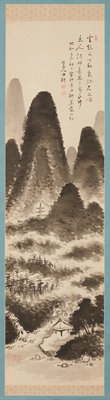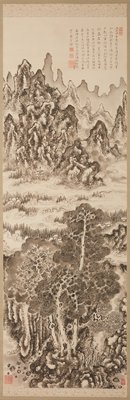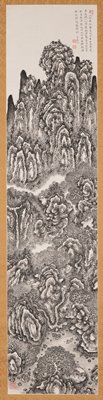
Title unknown; Winter, from a set of Landscapes of the Four Seasons
Fukuda Kodōjin
1929
- Medium
- Hanging scroll, ink on silk
- Dimensions
- 49 3/16 × 13 1/4 in. (124.94 × 33.66 cm) (image) 72 9/16 × 18 3/8 in. (184.31 × 46.67 cm) (mount, without roller )
Tags
Japan
About
Although a complex layering of snowcapped peaks dominates this wintry landscape, the painter has provided us with guides to assist us on our journey through the work. We enter at the bottom of the painting along with the scholar and his servant, who make their way into the mountains via a rocky river. Although the river quickly disappears, we can imagine that they are making their way toward the empty pavilion on a cliff in the right middleground. But we are not alone here—farther up, another figure is seated on a precipice. He looks out over a misty valley toward mountains in the distance. Fukuda Kodōjin and a handful of other scholar-artists carried the Nanga tradition into the 20th century, and his painting style is informed not only by famous painters from Chinese antiquity but also by earlier Japanese Nanga painters. Like other literati painters in East Asia, Kodōjin was not only a painter but also an accomplished scholar, poet, and calligrapher. Like most of his paintings, this one features a poem composed by Kodōjin, brushed in his own unique calligraphic style.