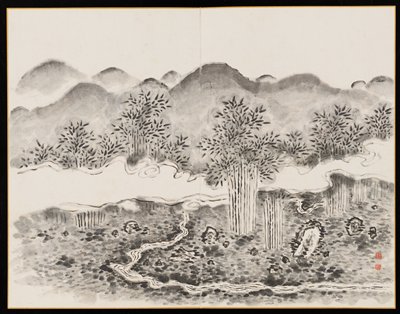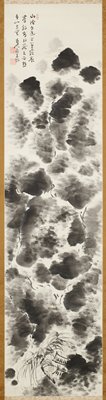
Landscape after Mi Fu; Summer, from a set of Landscapes of the Four Seasons
Fukuda Kodōjin
1929
- Medium
- Hanging scroll, ink on silk
- Dimensions
- 49 3/16 × 13 1/4 in. (124.94 × 33.66 cm) (image) 72 7/16 × 18 3/8 in. (183.99 × 46.67 cm) (mount, without roller)
Tags
Japan
About
This summer landscape shows several architectural structures—a Buddhist temple, indicated by the upper floors of a pagoda, a small village surrounded by pine trees, and an isolated pavilion in the foreground—all tucked into a landscape of misty peaks. Kodōjin created these rounded mountains by applying hundreds of dots in several tones of ink to the surface of the silk. This type of texturing of the mountains is commonly known as “Mi dots, ” a reference to the ancient Chinese painter Mi Fu (1051–1107), who developed this particular style, to which Kodōjin returned again and again throughout his career.