Dog Dance of the Dacotahs
Seth Eastman
1849
- Medium
- Watercolor
- Dimensions
- 6 3/4 × 10 1/8 in. (17.1 × 25.7 cm) (image) 17 9/16 × 21 1/2 × 1 1/8 in. (44.6 × 54.6 × 2.9 cm) (outer frame)
- Genre
- Drawings
Tags
United States
About
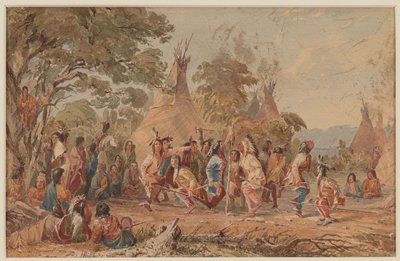
Seth Eastman owned an early daguerreotype—a coincidence since a relative founded Eastman Kodak in the 1890s—and may have used it to record this scene. Native people attached immense cultural meaning to the power of the photograph, which may account for the startled looks on the men near the middle (one pointing, one crouching). In the Dog Dance, Dakota villagers attempted to absorb canine virtues (Dakota people greatly admired dogs) by eating the heart and liver of a newly sacrificed dog. This prize had to be grabbed from the pole with teeth, not hands, as the picture shows. Other dancers mimic dog behavior. This watercolor, one of 35 works on paper by Eastman in Mia’s collection, was the basis for an illustration in Henry Rowe Schoolcraft’s massive Historical and Statistical Information Respecting the History, Condition, and Prospects of the Indian Tribes of the United States (Philadelphia: Lippincott, Grambo & Co., 1851-57).