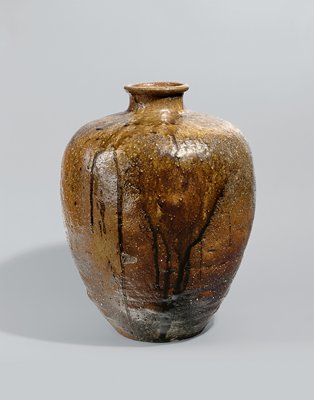
Storage jar
- Medium
- Shigaraki ware, stoneware with natural ash glaze
- Dimensions
- 18 × 13 3/4 × 13 5/8 in. (45.72 × 34.93 × 34.61 cm)
- Genre
- Ceramics
Tags
Japan
About
This large Shigaraki jar is noted for the brown ash glaze that pools and drips unevenly across its rough surface, which is marked by particles of white feldspar. Potters in Shigaraki began making bowls, jars, mortars, and other vessels for utilitarian use around a millennium ago. The irregular properties of the local clay and unique firing processes lent Shigaraki pots and bowls a sense of rusticity and spontaneity. Late in the fifteenth century, the ostensible artlessness of Shigaraki pottery drew the attention of tea masters like Murata Jukou (1423-1502) who embraced a new style of tea ceremony based on the unpretentious, austere aesthetic concept known as “wabi.”
![Sleeping Daruma, Ribbon and Branch on Head]](https://1.api.artsmia.org/31551.jpg)
![Manju [landscape, bridge and hut]](https://1.api.artsmia.org/30434.jpg)