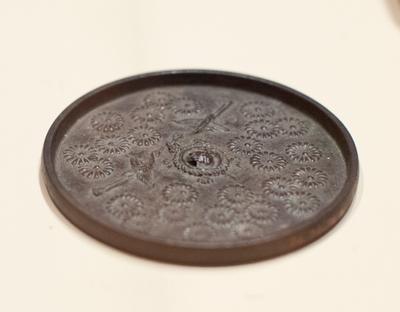
Round mirror with flying cranes surrounded by chrysanthemums
- Medium
- Bronze
- Dimensions
- 1/8 x 3 1/4 in. (0.32 x 8.26 cm)
- Genre
- Metalwork
Tags
Japan
About
The Japanese first imported mirrors from China during the Kofun period (250-552). One surface of these bronze disks was polished to be reflective; the other side was embellished with designs in relief. Because mirrors were thought to be magical, the designs were often formal and geometric, and they were placed in tombs in the belief that they could illuminate the darkness. By the Heian period (794-1185), mirrors were a standard element within cosmetic sets and their embellishment reflected secular tastes. Here, cranes are shown flying amid chrysanthemums. The central knob is in the shape of a tortoise. Both cranes and tortoises are symbols of longevity in Asia.


![Shoe with Frog on Underside]](https://1.api.artsmia.org/31550.jpg)

![Netsuke [dancing farmer with clam basket]](https://1.api.artsmia.org/30477.jpg)
![Netsuke [Man Riding on the Back of a Giant Toad]](https://1.api.artsmia.org/32059.jpg)