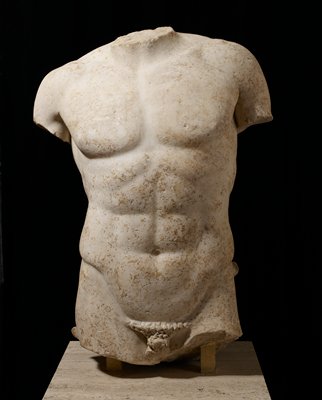
Torso
- Medium
- Marble
- Dimensions
- 34 3/4 x 25 x 14 1/2 in. (88.27 x 63.5 x 36.83 cm)
- Genre
- Sculpture
Tags
Italy
About
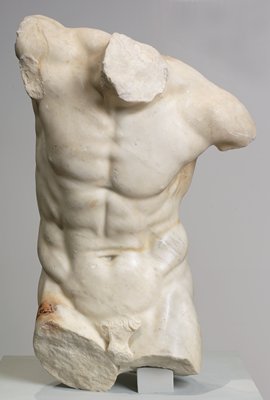
This larger-than-life torso, with its sensitively modeled anatomy, is an exquisite example of the kind of idealized male nude perfected by ancient Greek and Roman sculptors. Subtle movement introduced to the figure, with the slight inclination of the left shoulder and right hip, makes the work lifelike. The torso is a copy of an illustrious Greek sculpture from around 450 BCE, possibly related to celebrated—but lost—works like the Apollo of the Omphalos or Pheidias’s sculptures dedicated to the fallen warriors in the Battle of Marathon, which are only known from variants, literary descriptions, and coins.