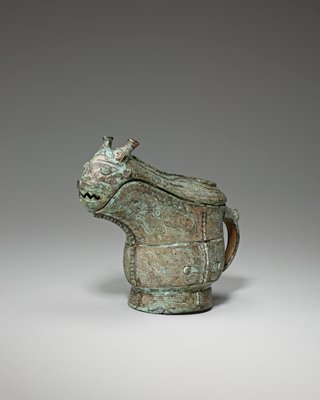
Gong wine vessel
- Medium
- Bronze
- Dimensions
- 7 × 9 5/16 × 2 1/16 in., 2.9 lb. (17.78 × 23.65 × 5.24 cm, 1.3 kg) 3 7/8 × 3 1/16 in. (9.84 × 7.78 cm) (object part, foot)
- Genre
- Metalwork
Tags
China
About
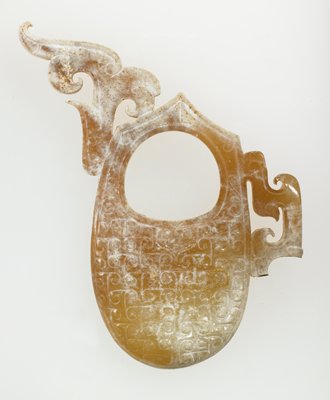
The gong is a type of ritual vessel used to serve wine during ceremonies. It was produced primarily during the late Shang (c. 1300–1046 BCE) and early Western Zhou (c. 1046–977 BCE) dynasties. This deep, boat-shaped pouring vessel displays almost perfect workmanship. Taotie (composite animal) masks are found on the handle and sides. Three dragons decorate the surface of the vessel. On the upper register to the right is a beaked dragon with recumbent C-shaped horn. The dragon under the spout of the vessel has a heart-shaped horn. Its enormous beak parallels the curve in the rim. The lid is fashioned as a dragon with the head of a beast, bottle-shaped horns, and a fierce mouth. Its long, sinuous body extends down the lid and loops at the end. All these features resemble those seen on a pair of gong excavated from the tomb of Fuhao, consort of King Wuding (r. c. 1250–1192 BCE), thus identifying Mia’s example as one of the earliest known gong.