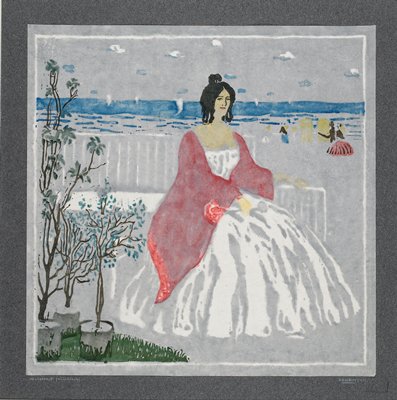
Am Strande
- Medium
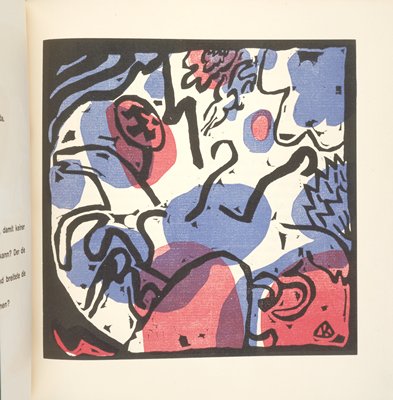
- Color woodcut printed from three blocks in blue, black, red, yellow, green, blue-green, and gray on Japan paper
- Dimensions
- 12 1/4 x 12 1/4 in. (31.12 x 31.12 cm) (image)
- Genre
Tags
russia
About
It makes sense that Vassily Kandinsky found woodcut to be a springboard to abstract painting. His color woodcuts forced him to flatten planes, ignore perspective, and reduce forms to their essentials, all of which would later be key to his abstractions. In 1903 and 1904 he made some forty-eight woodcuts, including On the Beach. The print's romantic mood can be traced to Kandinsky's personal life: in 1903 his student Gabriele Münter had joined him in the Bavarian town of Kallmünz, and he was falling deeply in love with her. Rather than typical oil-based color, Kandinsky inked his blocks with watercolor, resulting in a translucency well suited to his figure's exotic costume.