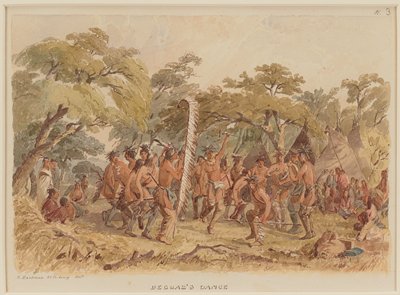
Beggar's Dance
Seth Eastman
1849
- Medium
- Watercolor
- Dimensions
- 6 1/4 × 8 15/16 in. (15.9 × 22.7 cm) (image) 9 9/16 × 12 3/4 in. (24.3 × 32.4 cm) (sheet) 17 9/16 × 21 1/2 × 1 1/8 in. (44.6 × 54.6 × 2.9 cm) (outer frame)
- Genre
- Drawings
Tags
United States
About
This event is a serious fundraiser. Pulsing with purpose, the group performs and cajoles to get the audience to contribute goods to those in need—hence the name Beggar’s Dance. In some communities, giving away one’s belongings demonstrated great depth of spirit and generosity. Could the pile at right be donations? Helping to rally excitement are the feather-lined standard and the feather bustles tied around the dancers’ waists. This traditional regalia invoked the power of birds and added a kinetic element to the dance. This watercolor, one of 35 works on paper by Seth Eastman in Mia’s collection, was the basis for an illustration in Henry Rowe Schoolcraft’s massive Historical and Statistical Information Respecting the History, Condition, and Prospects of the Indian Tribes of the United States (Philadelphia: Lippincott, Grambo & Co., 1851-57).