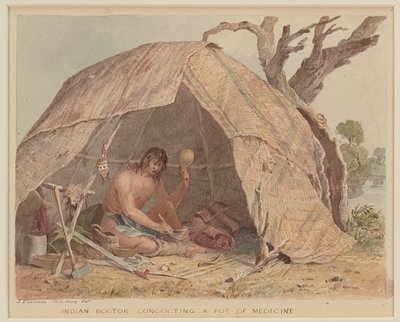
Indian Doctor Concocting a Pot of Medicine
Seth Eastman
1849
- Medium
- Watercolor
- Dimensions
- 6 3/4 × 8 3/4 in. (17.1 × 22.2 cm) (image) 9 3/4 × 12 15/16 in. (24.8 × 32.9 cm) (sheet) 17 9/16 × 21 1/2 × 1 1/8 in. (44.6 × 54.6 × 2.9 cm) (outer frame)
- Genre
- Drawings
Tags
United States
About
Like other American artists of the Romantic era, Seth Eastman occasionally idealized Native people. Here he gave a chanting, rattle-shaking healer the form of a classical hero, drawing on the sculptures and paintings he would have studied at West Point, possibly a cast of the Belvedere Torso (1st century C.E., Vatican Museums). Such parallels were meant to satisfy the 19th-century viewer’s longing to escape to a simpler, purer time, while conferring moral virtue on the figure. Other details show Eastman’s gift for observation. The woven basket may be for medicinal herbs, the little five-sided pouch for paint. The creature (maybe a opossum or otter) slung over the post is part of the healing process, as is the bird near the healer’s knee. This watercolor, one of 35 works on paper by Eastman in Mia’s collection, was the basis for an illustration in Henry Rowe Schoolcraft’s massive Historical and Statistical Information Respecting the History, Condition, and Prospects of the Indian Tribes of the United States (Philadelphia: Lippincott, Grambo & Co., 1851-57).