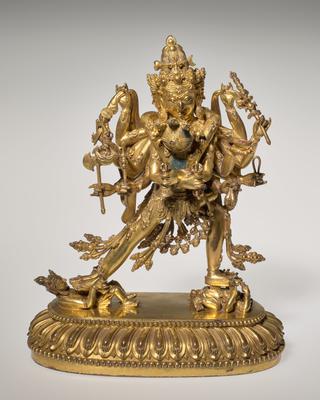
Khorlo Demchog Embracing Dorje Phagmo
Tibet
1403
- Medium
- Gilt bronze
- Dimensions
- 7 5/8 x 6 3/16 x 3 5/16 in. (19.37 x 15.72 x 8.41 cm)
- Genre
- Sculpture
Tags
Tibet
About
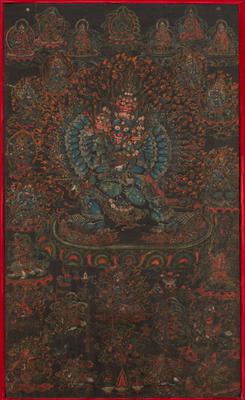
The embrace of the deity Khorlo Demchog (Sanskrit: Chakrasamvara) and his consort Dorje Phangmo (Sanskrit: Vajravārāhī) symbolizes the union of wisdom and compassion, an important principle of Vajrayana Buddhism. The four-faced, twelve-armed god holds Dorje Phangmo in his arms while trampling on the Hindu deities Bhairava and Kalaratri, who represent ignorance and evil. The image bears an imperial inscription dating it to the reign of the Yongle emperor of China (r. 1403–24). The emperor sought the services of Tibetan lamas, and missions to and from China involved the exchange of gifts, Buddhist images, and ritual objects.