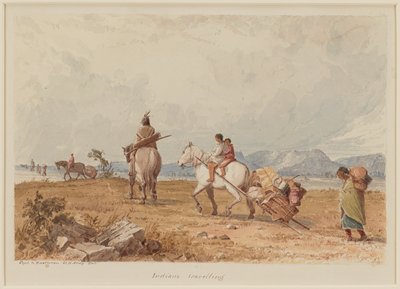
Indians Travelling
Seth Eastman
1850
- Medium
- Watercolor
- Dimensions
- 6 9/16 × 10 1/4 in. (16.7 × 26 cm) (image) 9 3/4 × 12 13/16 in. (24.8 × 32.5 cm) (sheet) 17 9/16 × 21 1/2 × 1 1/8 in. (44.6 × 54.6 × 2.9 cm) (outer frame)
- Genre
- Drawings
Tags
United States
About
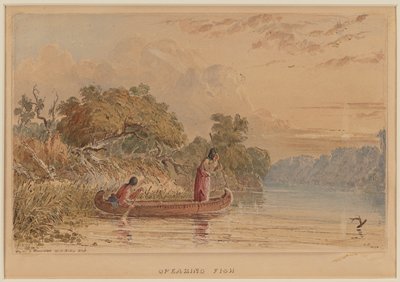
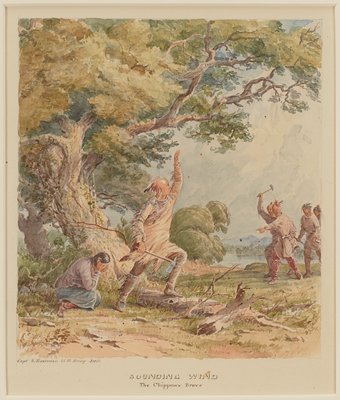
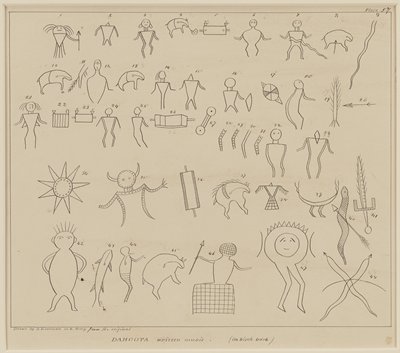
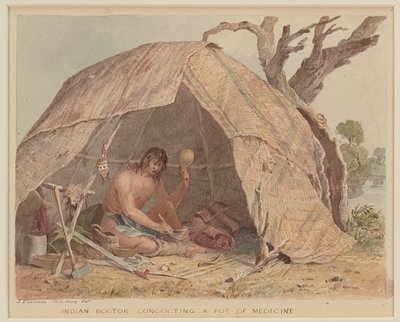
In this sentimentalized scene, Seth Eastman bows to an early 19th-century image of Native people as a “vanishing race.” Though he knew Native life well (he even learned the Dakota language), he could not escape his era’s romanticized views. He presented these villagers as quietly stoical, moving across barren land until they all but disappear. For added pathos, Eastman placed focus on the baby swaddled in pink and strapped to the travois, and had the child on horseback give the viewer a farewell glance. This watercolor, one of 35 works on paper by Eastman in Mia’s collection, was the basis for an illustration in Henry Rowe Schoolcraft’s massive Historical and Statistical Information Respecting the History, Condition, and Prospects of the Indian Tribes of the United States (Philadelphia: Lippincott, Grambo & Co., 1851-57).