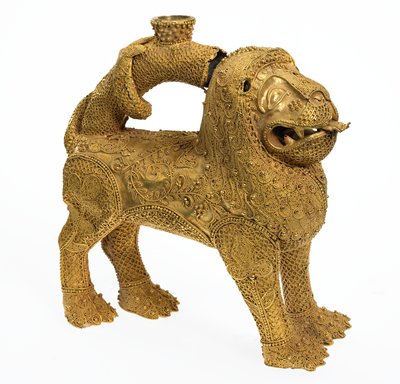
Statuette of a lion
- Medium
- Gold
- Dimensions
- 4 3/4 x 4 x 2in. (12.1 x 10.2 x 5.1cm)
- Genre
- Metalwork
Tags
Spain
About
This rare and enigmatic gold sculpture of a lion—a symbol of power and authority—is elaborately decorated with looping filigree and fine granulation, in keeping with the Islamic goldsmithing traditions of the later Muslim kingdoms of the Iberian Peninsula (present-day Spain and Portugal). Islam arrived in Europe in 711 CE, bringing new traditions in the decorative arts, such as the animal-shaped aquamanile: a vessel used for hand washing, which the Qur’an requires before prayer. While the handle, spout, and open mouth of this lion statuette complies with the forms of an aquamanile, its small scale may suggest more symbolic than functional use. The work closest in size, style, and workmanship to this lion is a winged ram found in northwestern Spain, leading us to believe that this work, too, is from Muslim Spain.