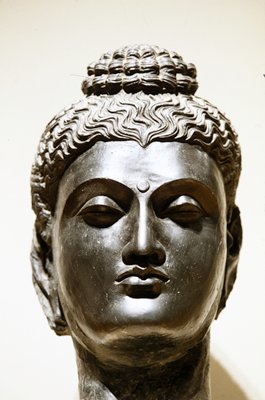
Head of Buddha
- Medium
- Gray schist
- Dimensions
- H.17-1/2 in.
- Genre
- Sculpture
Tags
Pakistan
About
Alexander the Great invaded India in 330 b.c. conquering the ancient kingdom of Gandhara which occupied much of present day Pakistan. This brought northwestern India into contact with the Mediterranean world and, from about the first to the late fourth century a.d., there flourished a Gandharan school of sculpture in which a mixture of Eastern and Western influences is evident. Certain characteristics of the Greco-Roman sculptural style were combined with Indian motifs and iconography to produce the stone images in grey schist that represents some of the earliest sculptural representations of the Buddha. The head is distinguished by facial features derived from classical sources such as its wavy hairstyle and natural physiognomy. The youthful face, half-shut eyes, and pensive expression connote the young Shakyamuni's spiritual searching.