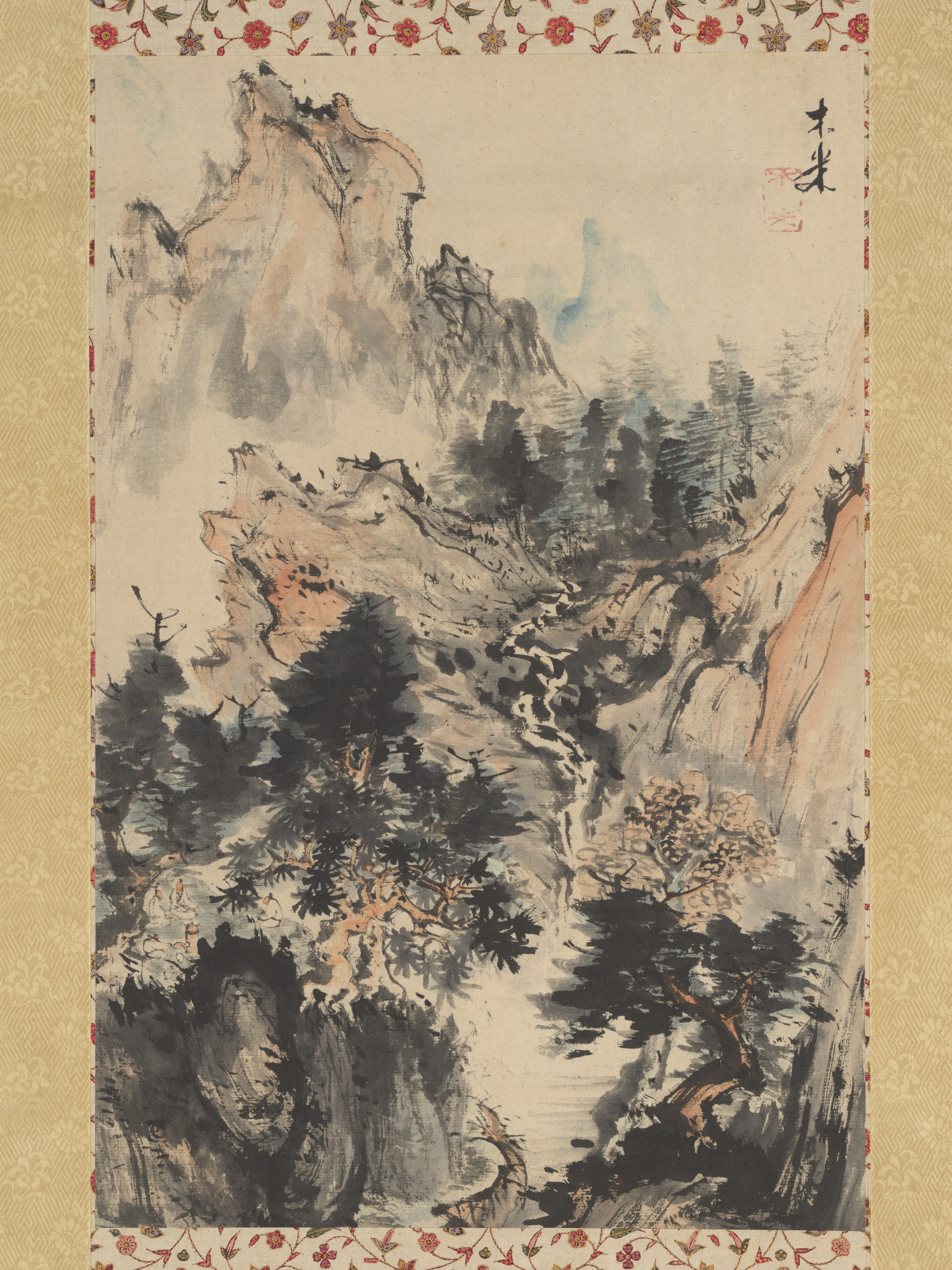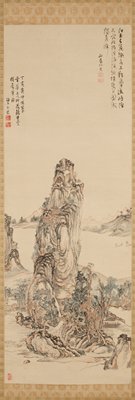
Duxiu Peak, after a Chinese painting
Aoki Mokubei
1827
- Medium
- Hanging scroll, ink and color on paper
- Dimensions
- 81 × 22 5/8 in. (205.74 × 57.47 cm) (without roller) 47 1/2 × 16 3/4 in. (120.65 × 42.55 cm) (image)
Tags
Japan
About
Japanese paintings of China often depict imagined locales, but this lone mountain peak rising dramatically at river’s edge is an actual place: Duxiufeng, or “Solitary Beauty Peak, ” on the banks of the Li River in south-central China. In the late 1300s, this mountain—which poets described as so beautiful that no other mountain could compare—was chosen as the site for an enormous estate constructed for a prince under the first emperor of the Ming dynasty (1368–1644), the Hongwu emperor. Thereafter, generations of imperial princes called the palace home until the mid-1700s, when the dynasty came to an end. Even today the site is dubbed “City of Princes.” The mountain, palace, and the site’s 5, 000-foot-long walls are all described in an inscription in the upper right of the painting by Rai San’yō (1780–1832), a scholar in Japan’s capital of Edo (now Tokyo). Another inscription, at left, is by the painter himself, who records that he modeled this work after a Chinese painting he had seen in a friend’s collection.