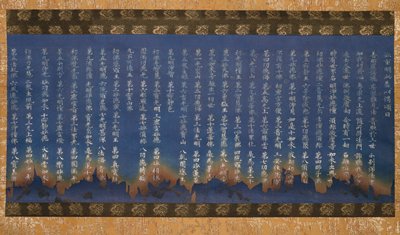
Fragment from Volume 53 of the Flower Garland Sutra, one of the “Burnt Sutra Fragments”
- Medium
- Silver ink on indigo paper
- Dimensions
- 9 3/8 × 21 13/16 in. (23.81 × 55.4 cm) (image) 42 1/4 × 28 1/2 in. (107.32 × 72.39 cm) (mount, without roller )
- Genre
- Calligraphy
Tags
Japan
About
The Japanese writing system consists of a syllabary (symbols that represent a syllable) and Chinese characters. While non-elite Japanese had access to basic education, the ability to read and write Chinese texts was limited to aristocrats, warriors, and the clergy. Buddhist texts, which arrived in Japan through China, were written entirely in Chinese characters, as seen here. This burnt fragment originally belonged to a multivolume set of handscrolls. The use of expensive and luxurious materials like indigo-dyed paper and silver ink suggests that the handscroll was likely commissioned by an elite. Sutras are the discourses of the Buddha that constitute the basic text of Buddhist scripture, and the act of copying them by hand was an important way of not only disseminating the Buddha’s words but also acquiring merit. The Flower Garland Sutra (Kegon kyō) was central to the Kegon school of Buddhism in Japan.