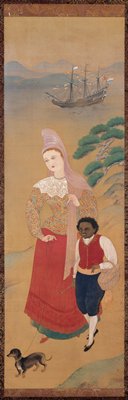
Dutch Lady with Servant
- Medium
- Hanging scroll, ink and color on silk
- Dimensions
- 42 × 13 9/16 in. (106.68 × 34.45 cm) (image)
- Genre
- Paintings
Tags
Japan
About
Concerned about the spreading Christianization of the country, the Japanese government expelled foreign missionaries and merchants in 1639 with the exception of the Dutch East India Company who was permitted to maintain trade relations from the island of Dejima in the bay of Nagasaki. Books and images provided by the Dutch were the only source of western-style images and some Japanese artists began to produce paintings of European scenes or of the merchants themselves. Kawahara Keiga (1786–1860?), for example, created portraits of Captain Jan Cock Blomhoff and his wife Titia as well as their Indonesian servant Maraty. This unsigned work might have been created by a follower of Keiga, using one of his portraits as model.


![Bulbul on a Plum Tree [right of a pair]](https://1.api.artsmia.org/122112.jpg)