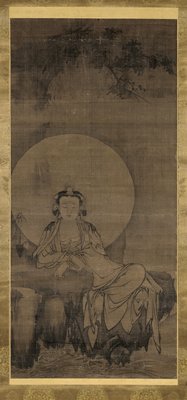
White-robed Kannon
- Medium
- Hanging scroll, ink on silk
- Dimensions
- 44 15/16 × 20 3/4 in. (114.14 × 52.71 cm) (image) 84 3/4 × 27 1/4 in. (215.27 × 69.22 cm) (mount, without roller)
- Genre
- Paintings
Tags
Japan
About
In this medieval Zen devotional painting, Kannon reclines on a rocky seaside ledge at his eternal dwelling, the island paradise of Fudaraku. The anonymous artist, probably a Zen priest-painter, uses carefully gradated washes of diluted ink to suggest the damp surface of the rocky ledge and the mistiness of Kannon’s watery paradise. Numerous forms of the bodhisattva Kannon exist within the vast Buddhist pantheon, including abstruse forms with eleven heads and a thousand arms. The strikingly human form of Kannon seen here, wearing white robes and seated in nature, was popular in the Zen school of Buddhism.


![Netsuke [fox woman]](https://1.api.artsmia.org/30488.jpg)
![Seal-form Netsuke [two men]](https://1.api.artsmia.org/30472.jpg)
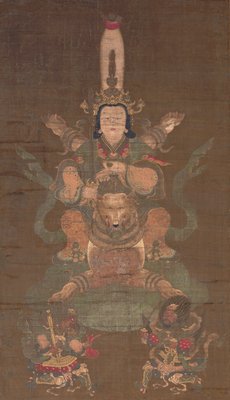
![Suiten, the Water Deity [one of a set of Twelve Devas]](https://1.api.artsmia.org/10333.jpg)