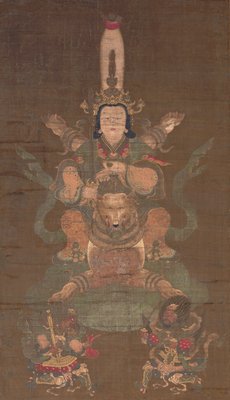
Dakiniten, the Buddhist Manifestation of the Shinto Deity Inari
- Medium
- Hanging scroll, ink and color on silk
- Dimensions
- 26 7/16 × 15 1/4 in. (67.15 × 38.74 cm) (image) 59 1/2 × 21 13/16 in. (151.13 × 55.4 cm) (with rollers)
- Genre
- Paintings
Tags
Japan
About
Buddhism officially entered Japan in the mid-500s, and by the 800s, Japanese Buddhists had developed a theory that kami, native gods, were incarnations of Buddhist deities. The figure of Dakiniten in this scroll exemplifies Buddhism’s ready assimilation of native gods. In Hinduism, a ḍākinī is a female spirit or deity who eats the flesh and heart of humans nearing death. In Japan, the deity entered the Buddhist canon as a converted Hindu goddess, Dakiniten. Dakiniten was further conflated with the Shinto kami (deity) Inari, who was associated with abundance, especially of rice. Here, she is shown riding a white fox, another representation of Inari. The fox’s legs are wrapped in snakes, a reference to another converted Hindu goddess, Benzaiten.

![Netsuke [Man with Monkey on Back]](https://1.api.artsmia.org/31671.jpg)