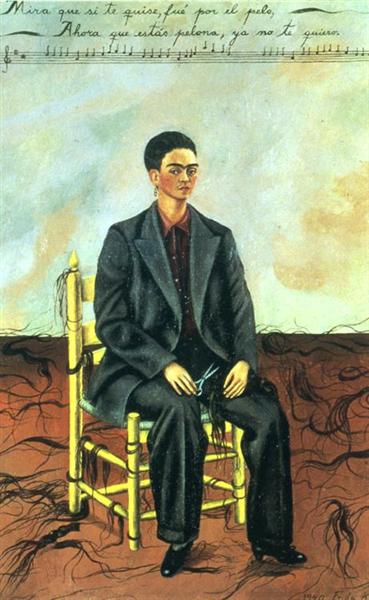
Self Portrait with Cropped Hair
Frida Kahlo
1940
- Dimensions
- 28 × 40 cm
- Genre
- Self-portrait
Styles
Tags
Frida-Kahlofamous-peopleGentlemanfemale-portraits
About
This self-portrait shows Kahlo as an androgynous figure. Scholars have seen this gesture as a confrontational response to [url href=https://www.wikiart.org/en/diego-rivera]Rivera[/url]'s demand for a divorce, revealing the artist's injured sense of female pride and her self-punishment for the failures of her marriage. Her masculine attire also reminds the viewer of early family photographs in which Kahlo chose to wear a suit. The cropped hair also presents a nuanced expression of the artist's identity. She holds one cut braid in her left hand while many strands of hair lie scattered on the floor. The act of cutting a braid symbolizes a rejection of girlhood and innocence, but equally can be seen as the severance of a connective cord (maybe umbilical) that binds two people or two ways of life. Either way, braids were a central element in Kahlo's identity as the traditional [i]La Mexicana[/i], and in the act of cutting off her braids, she rejects some aspect of her former identity. The hair strewn about the floor echoes an earlier self-portrait painted as the Mexican folkloric figure [i]La Llorana,[/i] here ridding herself of these female attributes. Kahlo clutches a pair of scissors, as the discarded strands of hair become animated around her feet; the tresses appear to have a life of their own as they curl across the floor and around the legs of her chair. Above her sorrowful scene, Kahlo inscribed the lyrics and music of a song that declares cruelly, "Look, if I loved you it was for your hair, now that you are hairless, I don't love you anymore," confirming Kahlo's own denunciation and rejection of her female roles. In likely homage to Kahlo's painting, Finnish photographer [url href=https://www.wikiart.org/en/elina-brotherus]Elina Brotherus[/url] photographed [url href=https://www.wikiart.org/en/elina-brotherus/wedding-portraits-1997][i]Wedding Portraits[/i][/url] in 1997. On the occasion of her marriage, Brotherus cuts her hair, the remains of which her new husband holds in his hands. The act of cutting one's hair symbolic of a moment of change happens in the work of other female artists too, including that of [url href=https://www.wikiart.org/en/francesca-woodman]Francesca Woodman[/url] and [url href=https://www.wikiart.org/en/rebecca-horn]Rebecca Horn[/url].