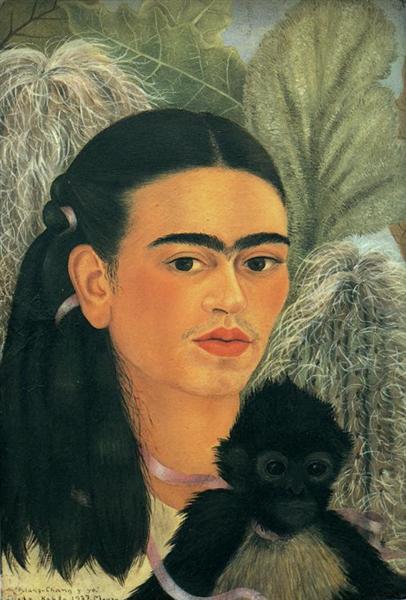
Fulang-Chang and I
Frida Kahlo
1937
- Dimensions
- 28 × 40 cm
- Genre
- Self-portrait
Styles
Tags
Frida-KahloBlack hairfamous-peopleanimalsmonkeysPrimatefemale-portraitsHair
About
This painting debuted at Kahlo's exhibition in Julien Levy's New York gallery in 1938, and was one of the works that most fascinated André Breton, the founder of [url href=https://www.wikiart.org/en/artists-by-art-movement/surrealism]Surrealism[/url]. The canvas in the New York show is a [url href=https://www.wikiart.org/en/paintings-by-genre/self-portrait]self-portrait[/url] of the artist and her spider monkey, Fulang-Chang, a symbol employed as a surrogate for the children that she and [url href=https://www.wikiart.org/en/diego-rivera]Rivera[/url] could not have. The arrangement of figures in the portrait signals the artist's interest in [url href=https://www.wikiart.org/en/paintings-by-style/high-renaissance]Renaissance[/url] paintings of the Madonna and Child. After the New York exhibition, a second frame containing a mirror was added. The later inclusion of the mirror is a gesture inviting the viewer into the work: it was through looking at herself intensely in a mirror in her months spent at home after her bus accident that Kahlo first began painting portraits and delving deeper into her [i]psyche[/i]. The inclusion of the mirror, considered from this perspective, is a remarkably intimate vision into both the artist's aesthetic process and into her personal introspection. In many of [url href=https://www.wikiart.org/en/frida-kahlo/all-works#!#filterName:Genre_self-portrait,resultType:masonry]Kahlo's self-portraits[/url], she is accompanied by monkeys, dogs, and parrots, all of which she kept as pets. Since the Middle Ages, small spider monkeys, like those kept by Kahlo, have been said to symbolize the devil, heresy, and paganism, finally coming to represent the fall of man, vice, and the embodiment of lust. These monkeys were depicted in the past as a cautionary symbol against the dangers of excessive love and the base instincts of man. Kahlo again depicts herself with her monkey in both [url href=https://www.wikiart.org/en/frida-kahlo/self-portrait-with-a-monkey-1938]1938[/url] and [url href=https://www.wikiart.org/en/frida-kahlo/self-portrait-with-monkey-1940]1940[/url]. In a later version in [url href=https://www.wikiart.org/en/frida-kahlo/self-portrait-with-small-monkey-1945]1945[/url], Kahlo paints her monkey and also her dog, [i]Xolotl[/i]. This little dog that often accompanies the artist, is named after a mythological Aztec god, known to represent lightning and death, and also to be the twin of [i]Quetzalcoatl[/i], both of who had visited the underworld. All of these pictures, including [i]Fulang-Chang and I[/i] include 'umbilical' ribbons that wrap between Kahlo's and the animal's necks. Kahlo is the Madonna and her pets become the holy (yet darkly symbolic) infant for which she longs.