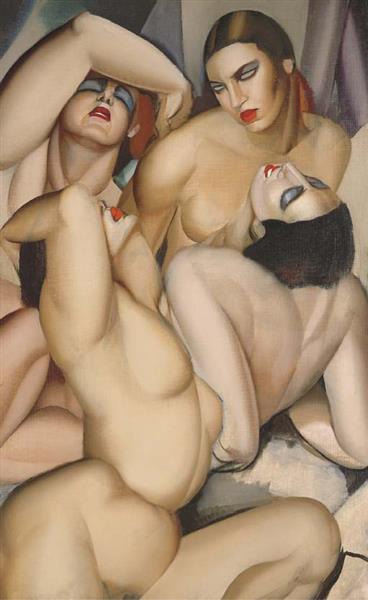
Group of Four Nudes
- Genre
- Nude painting (nu)
Styles
About
Lempicka's [i]Four Nudes[/i] (1925) exudes eroticism and powerful femininity. In the picture, four contorted, nude women recline in a complex tangle of rounded, heavily modeled, and sharply outlined body parts. The robust, sensual figures with their sultry expressions are reminiscent of the nude bathers of Lempicka's artistic predecessors - from [url href=https://www.wikiart.org/en/jean-auguste-dominique-ingres]Ingres[/url] and [url href=https://www.wikiart.org/en/eugene-delacroix]Delacroix[/url] to [url href=https://www.wikiart.org/en/henri-matisse]Matisse[/url] and [url href=https://www.wikiart.org/en/pablo-picasso]Picasso[/url]. Lempicka's figures have been likened to Ingres's fleshy and distorted but elegant bathers, such as those pictured in the work, [url href=https://www.wikiart.org/en/jean-auguste-dominique-ingres/the-turkish-bath-1863][i]Turkish Baths[/i][/url] (1862). However, the piece must also be analyzed in comparison to [url href=https://www.wikiart.org/en/paintings-by-style/cubism]Cubist[/url] works, including but not exclusively, nudes by Picasso such as [[url href=https://www.wikiart.org/en/pablo-picasso/nudes-interlaces-1905]i]Two Nudes[/i][/url] (1905) or for that matter, the groundbreaking [url href=https://www.wikiart.org/en/pablo-picasso/the-girls-of-avignon-1907][i]Les demoiselles d'Avignon[/i][/url] (1907). Lempicka absorbed tradition but was also deeply influenced by Cubism. The shallow background of the picture, which is typical of post-Cubist compositions, has the effect of making the women feel even more compressed within the space, thereby also heightening the eroticism. Art historian Joan Cox argues that "[Lempicka] has chosen to crop her view of the female bathers tightly and give the viewer - a presumably female viewer - the experience of joining in the frolicking. She invites the female viewer in as a lover rather than creating an experience for a male viewer as a distant voyeur into this all-female public space." Indeed, works like the nude groupings by Ingres and Picasso presume a male viewer as, at the least, the artists themselves were males. Lempicka subverts that dynamic and, in a way, excludes male viewers altogether.