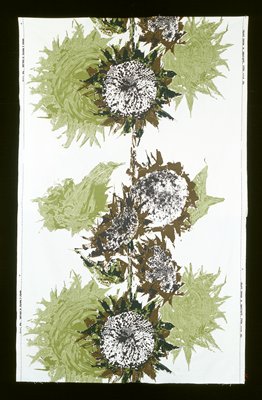
Sunflower
Howard Carter
1962
- Medium
- Cotton, screenprint
- Dimensions
- 119 x 48 1/2 in. (302.26 x 123.19 cm)
- Genre
- Textiles
Tags
England
About
Carter's Sunflower textile shows the early 1960s trend for giant and painterly botanicals on a white ground, which became popular among designers. Sunflower won the 1962 Council of Industrial Design Award and thereafter became very influential, even resulting in a number of imitations. Carter, influenced strongly by Abstract Expressionism, created this piece with purposeful spontaneity and disorder, causing a design that is textural and seemingly three-dimensional. His approach introduces individuality and complexity for a screen-printed piece, compared to other patterns of the era, which tended to exploit the flat qualities of the fabric surface. Heal's was known for both employing freelance and salaried designers, which created a reputation for innnovation but also for reliability. The 1960s were a successful time for Heal's, as they averaged 30 new textile designs a year. In the mid 1960s they began introducing fabrics influenced by the Op Art movement, of which Sunflower can be seen as a precedent.
