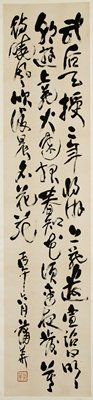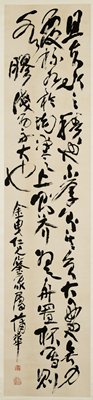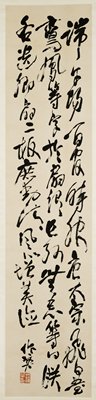
Four Scrolls in Running Script
- Medium
- Ink on paper
- Dimensions
- 90 3/8 x 20 in. (229.55 x 50.8 cm) (image) 114 9/16 x 25 in. (290.99 x 63.5 cm) (without roller)
- Genre
- Calligraphy
Tags
China
About
P'u Hua received a solid Confucian education and became a proficient scholar, poet, painter, and calligrapher. P'u became a close friend of the artist, Wu Ch'ang-shuo in Shanghai and, as member of Wu's circle, became successful at interpreting traditional styles with a new found freedom and personality. Completed late in life, this extraordinary set of four, large calligraphic hanging scrolls is executed in a wild, effusive hsing-shu (running script) trembling with barely controlled vitality. The four early texts are only randomly connected, and were apparently selected by the dedicatee, Mr. Chin-i; one from the I Ching and one from Chuang-tzu, the other two being accounts of emperor T'ai-tsung and empress Wu of the T'ang dynasty (8th century). The verse (concerned with the relativity of things) from the Chuang-tzu (Zhuangzi) Chapter One, circa 4th century BCE reads: If water is not deeply enough accumulated, then in supporting a boat, it will lack sufficient strength. If you pour a cup of water in a small hole in the ground, then a mustard seed can serve as a boat therein, but if you place a cup in it, it will get stuck in the shallow water as it is too large a boat.