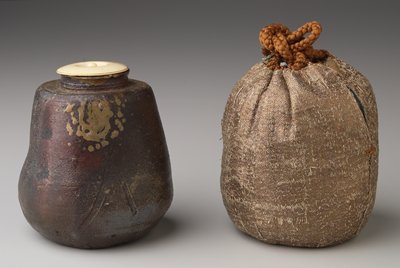
Tea caddy
- Medium
- Bizen ware, stoneware with natural ash glaze, lid: ivory, brocade bag
- Dimensions
- 3 3/8 x 3 x 2 7/8 in. (8.57 x 7.62 x 7.3 cm)
- Genre
- Ceramics
Tags
Japan
About
Beginning in the 1300s, Japanese potters in and around Imbe village in the old province of Bizen produced a variety of sturdy utilitarian vessels using the local, iron-rich clay. The unglazed, rich reddish-brown clay later appealed to tea masters like Sen no Rikyū (1522–1591), who is credited with profoundly shaping the Japanese tea ceremony in the late 1500s and is known to have prized accidental kiln effects. This small, finely crafted tea caddy exhibits the gomayū (sesame seed glaze) effect in which small yellowish beads of natural ash glaze form in the firing process. This caddy was once owned by Sotsutaku-sai (1744–1808), the eighth-generation head of the Omotesenke, one of the three schools of the tea ceremony that carry on the tradition of Sen no Rikyū.
![Netsuke [Flower]](https://1.api.artsmia.org/31665.jpg)
![Dessert stand [one of four]](https://1.api.artsmia.org/29649.jpg)

![Netsuke [Awabi shell]](https://1.api.artsmia.org/30388.jpg)
![Gatten, the Moon Deity [one of a set of Twelve Devas]](https://1.api.artsmia.org/10348.jpg)