![Fall [right from the set Rice Farming in the Four Seasons]](https://1.api.artsmia.org/96540.jpg)
Fall [right from the set Rice Farming in the Four Seasons]
- Medium
- Sliding door (fusuma), ink, light color, and gold on paper
- Dimensions
- 76 x 39 1/4 x 4 in. (193.04 x 99.7 x 10.16 cm)
- Genre
- Paintings
Tags
Japan
About
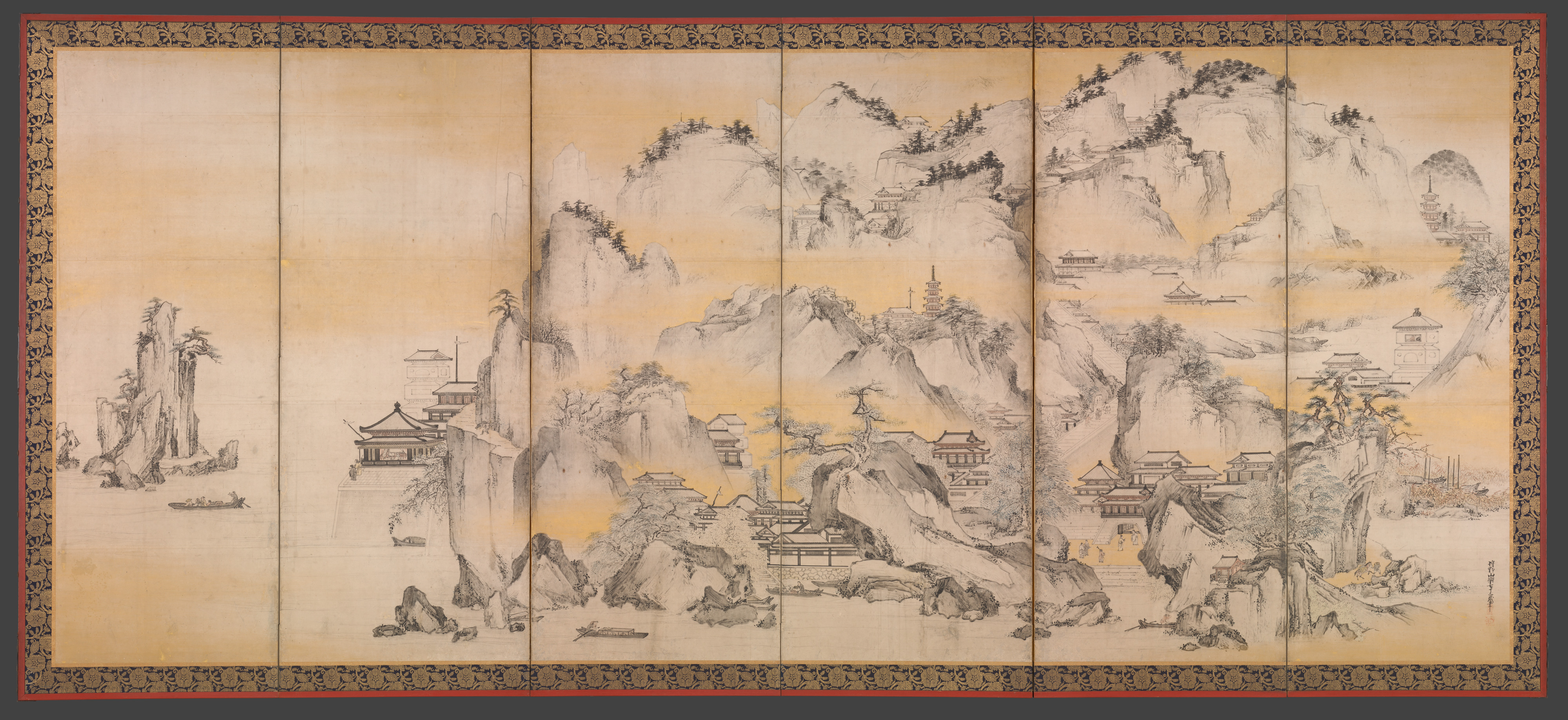
These sliding door panels originally formed the four walls of a small reception chamber at Daikakuji, a Buddhist temple in northwest Kyoto that also served as the palace for Japan’s emperor. The panels form a continuous panorama from wall to wall and present various activities associated with rice cultivation: plowing, transplanting the rice, irrigating, threshing, and grinding. The didactic theme is derived from Chinese painting; agriculture, according to Confucian teachings, is the basis of a well-ordered society. Accordingly, when Japanese rulers adopted Confucianism as their ruling ideology, they also commissioned paintings that reflected social stability, morality, and government values. Although unsigned, these paintings were likely produced by Kano Sanraku. As head of the Kyoto branch of the influential Kano school, Sanraku counted several prominent aristocratic families and Buddhist monasteries, including Daikakuji, as key patrons.
![Spring [left from the set Rice Farming in the Four Seasons]](https://1.api.artsmia.org/95014.jpg)
![Winter [center right from the set Rice Farming in the Four Seasons]](https://1.api.artsmia.org/96530.jpg)
![Spring [center right from the set Rice Farming in the Four Seasons]](https://1.api.artsmia.org/96533.jpg)
![Winter [left from the set Rice Farming in the Four Seasons]](https://1.api.artsmia.org/22412.jpg)
![Summer [right from the set Rice Farming in the Four Seasons]](https://1.api.artsmia.org/96537.jpg)