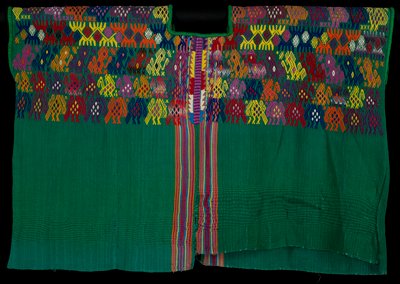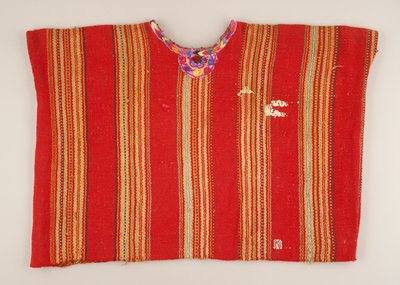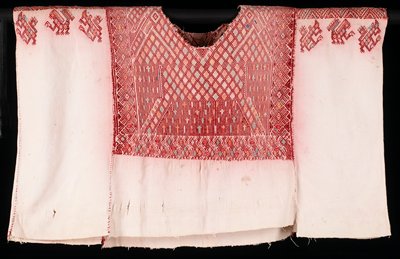
Cofradía blouse (huipil)
Maya artist
1910
- Medium
- Cotton, silk
- Dimensions
- 24 3/4 x 39 1/4 in. (62.87 x 99.7 cm)
- Genre
- Clothing, textiles
Tags
Guatemala
About
In this huipil, the red from the silk yarn has bled onto the white cotton fabric. Although it was common knowledge that silk yarns were not color-fast, the weaver's decision to use the brightly-colored yarn was a deliberate artistic choice. The run-off from the dye did not ruin her garment; instead, it showcased the artist's ability to purchase expensive, imported silk. This prestige blouse would be worn to a cofradía ceremony, further solidifying her high status as a woman of honor and responsibility. The cofradía is a community-based religious group, responsible for ceremonies as well as the care of their local Catholic church. A careful inspection of the delicate embroidery reveals a large double-headed eagle. Stylistically inspired by the heraldic eagle of the Hapsburg royal family of Spain, the motif also represents the continued prevalence of pre-Conquest cosmology and imagery. The eagle's ability to turn its head to look both forward and backward is a manifestation of the Mayan concept of duality.