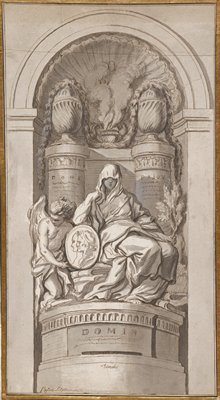
Study for a Funerary Monument
Augustin Pajou
1750
- Medium
- Black chalk, pen and brown ink, brown and gray washes, white heightening on two joined sheets
- Dimensions
- 15 9/16 x 8 3/8 in. (39.6 x 21.3 cm) (image) 23 3/4 × 19 3/4 in. (60.33 × 50.17 cm) (outer frame)
- Genre
- Drawings
Tags
france
About
Augustin Pajou’s earliest known drawing, this study testifies to the twenty-year-old sculptor’s excellent draftsmanship, for which he was celebrated throughout his career. The two portrait profiles on the medallion and the pair of urns indicate that this is a double tomb for a husband and wife. Pajou’s family name is inscribed on one of the columns, but in light of his humble origins and modest financial situation, this monument seems an entirely fanciful exercise. The tomb displays the full panoply of funeral iconography established by the high nobility. The difficulty of adapting it for a family of carpenters and sculptors might account for Pajou’s drawing a rather unspecific pleurante (mourner) holding a laurel branch as the main figure. The books piled under the portrait medallion on the pedestal emphasize the deceased’s erudition rather than any specific accomplishments or skills, let alone of a manual kind. An identification of the couple meant to be honored by the imaginary tomb is conjectural, and even the inscriptions remain mysterious.
![Angel from the Assumption [recto]](https://api.nga.gov/iiif/93462950-9194-4394-85f0-4e381ec3ea37/full/843,/0/default.jpg)

![The Ripetta in Rome [verso]](https://api.nga.gov/iiif/f0fb1e1f-4e5c-4956-9bd8-57d9ddbe520e/full/843,/0/default.jpg)