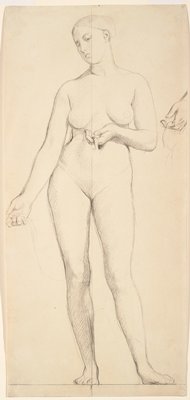
Standing Female Nude, Study for Saint Bathilde
- Medium
- Black chalk on paper
- Dimensions
- 14 3/8 x 6 5/8 in. (36.5 x 16.9 cm) (image) 23 3/4 × 19 3/4 in. (60.33 × 50.17 cm) (outer frame)
- Genre
- Drawings
Tags
france
About
Jean-Auguste-Dominique Ingres was a perfectionist, obsessively reworking paintings, sometimes for decades, and making thousands of drawings. He drew this study from a live model when he was in his mid-sixties. Ingres routinely made life studies of all the figures in his compositions, posing models and drawing them in the nude to ensure anatomical accuracy, even when the final versions would be clothed. The curvaceous, coolly sensuous figure in this study would become a virtuous female saint heavily cloaked in a medieval costume in a stained-glass window in the royal burial chapel at Dreux, France. During research for this exhibition, it was discovered that this work was stolen by the Nazis in France in 1941 from the Jewish collector David David-Weill. The theft was meticulously documented by the Germans when the work was processed at the Jeu de Paume museum in Paris, before being sent to the Altaussee salt mines in Austria. The drawing was restituted after the war, on March 27, 1946, and David-Weill’s heirs sold it to a dealer in 1971.