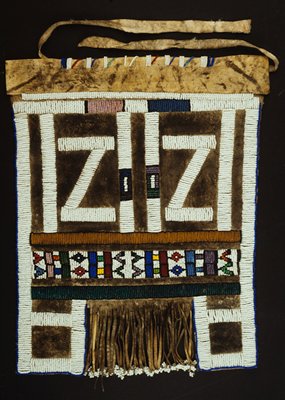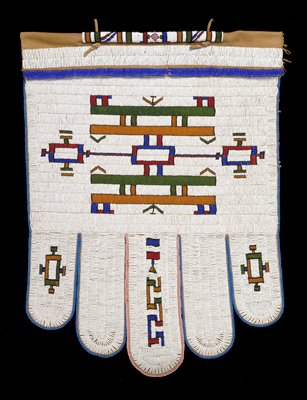
Beaded Apron (Jocolo)
- Medium
- Leather backed by cloth, glass beads, 2 leather thongs
- Dimensions
- 27 x 20 1/4 in. (68.58 x 51.44 cm)
- Genre
- Clothing
Tags
South Africa
About
Throughout their lives, Southern African Ndebele women wear various aprons that mark stages of social advancement. Pre-adolescent girls wear an apron of one solid piece, called a ghabi; when they reach adolescence, they start wearing a pepitu, recognizable by its simple embellishment and lack of flaps. After marriage, a woman wears more elaborately adorned aprons: the mapoto, for everyday use, has two square flaps; the jocolo, with five rounded flaps, is typically reserved for special occasions. The jocolo on display here is made with very small glass beads, suggesting it was made between 1900 and 1950. After that time, larger beads—some made of plastic—became more popular.