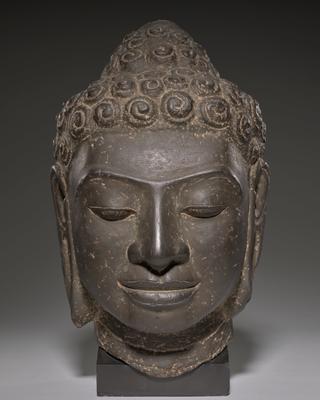
Buddha Head
- Medium
- Limestone
- Dimensions
- 10 1/2 x 8 in. (26.67 x 20.32 cm)
- Genre
- Sculpture
Tags
Cambodia, Thailand
About
This Buddha demonstrates a critical innovation of Southeast Asian sculpture: the early translation of established Indian prototypes into distinctly local expressions. The sculptor fully captures the calm bliss of the enlightened being while subtly incorporating the facial features of the indigenous population. Similarly, artists of the Mon-Dvaravati period exaggerated the Buddha’s snail-shell curls, an attribute codified in Indian aesthetic treatises; the tight whorls would have had special significance to a culture where shells were valued forms of ornamentation.