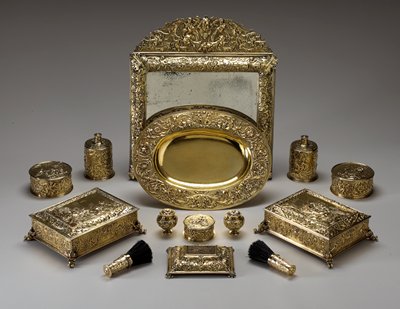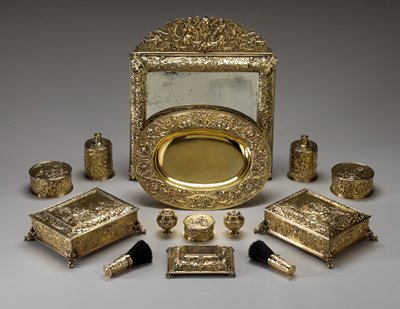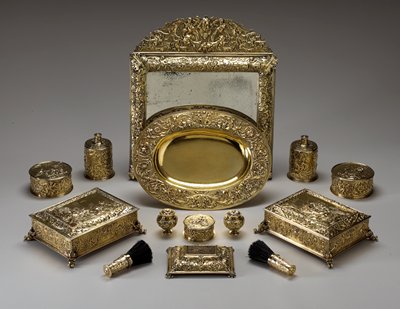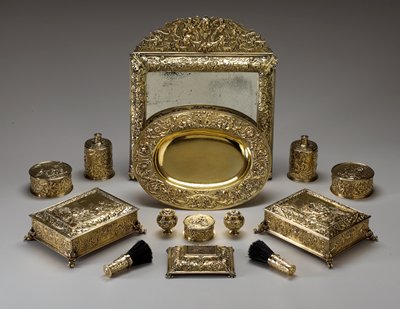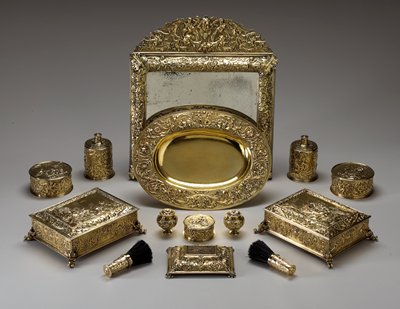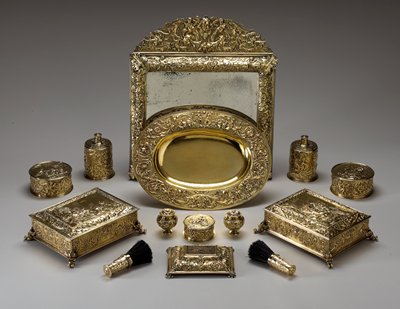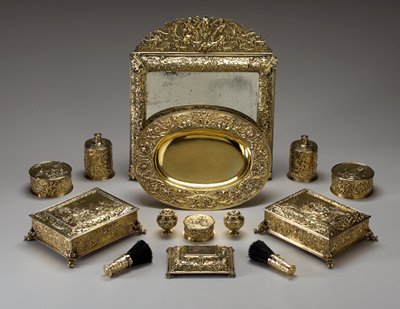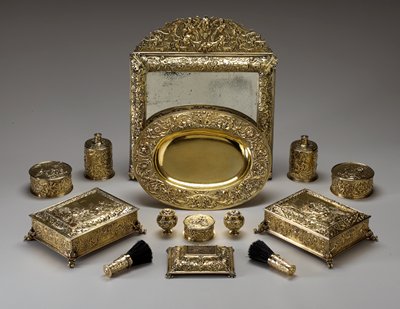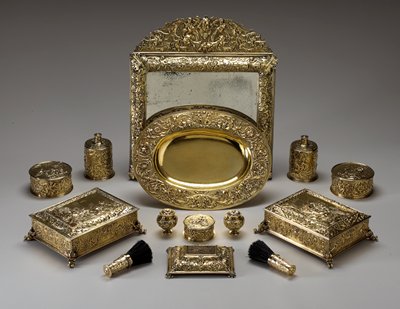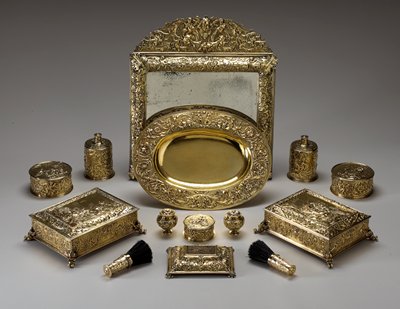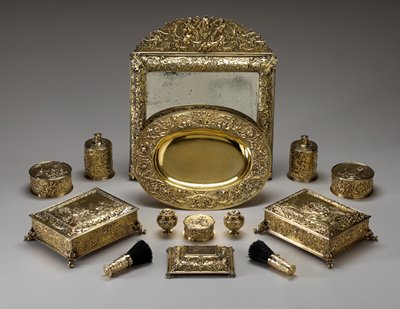
Mirror on a stand, from a toilette service
William Fowle
1683
- Medium
- Silver, gilt, mirror glass, silk, horsehair, wood
- Dimensions
- 20 x 17 1/2 x 1 5/16 in. (50.8 x 44.45 x 3.33 cm)
- Genre
- Metalwork
Tags
England
About
During the Baroque era, a lady and her lady-in-waiting could spend hours at the dressing table with soaps, creams, perfumes, brushes, pins, etc. This manner of ceremonial grooming originated in the French court, where the word toilette developed from toile, or cloth, which covered the table. As the ceremony grew more elaborate, so too did the dressing table service that housed these beauty secrets. Surviving correspondence from silversmith himself identifies the elements of this service have been identified as follows: a rectangular mirror; an oval basin; two 'comb boxes, ' one featuring Venus and Adonis, one with the Death of Adonis; two powder boxes, one with Phaeton in his chariot, the other with Phaeton falling to Earth; a cylindrical patch box with Hercules on its cover; two 'sweet-water bottles' for perfume; a rectangular pin-cushion; two 'jessemy boxes, ' for jasmine oil; and two brushes (later additions). The figural plaquettes depict scenes from Ovid's Metamorphoses. This set once belonged in the collection of financier and art collector J. P. Morgan. Among the very few services of this type, quality, and completeness, one can be found in the Devonshire Collection at Chatsworth in England, and one by the same maker is at the Victoria and Albert Museum in London.