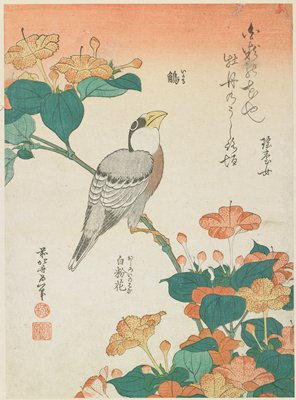
Hawfinch and Marvel-of-Peru
- Medium
- Woodblock print (nishiki-e), ink and color on paper
- Dimensions
- 9 5/8 × 7 1/16 in. (24.5 × 17.9 cm) (image, sheet, vertical chūban)
- Genre
Tags
Japan
About
Four-o’clocks were introduced to Japan in the early 17th century and became popular among amateur horticulturists. To protect the flowers from direct sunlight, gardeners typically planted four-o’clocks near a fence, as mentioned in the poem. In contrast to the large, showy blooms of peonies, the “king of flowers, ” which thrive in sunlight, four-o’clock blossoms are small and modest, discreetly opening late in the day and withering in the morning sun. Orange gradation along the print’s upper edge suggests sunset, when four-o’clocks are open. The poem is ascribed to “a woman of Yōdai.” A reference to fairyland or the moon, Yōdai implies the poet has super- natural beauty. Four-o’clocks bloom near the fence behind the peonies.