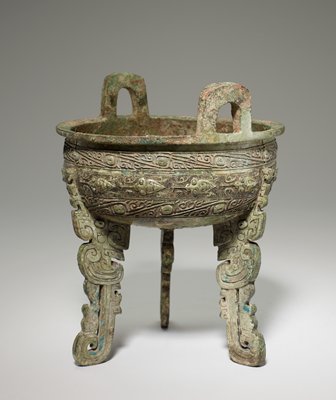
Ding food vessel
- Medium
- Bronze
- Dimensions
- 7 11/16 × 6 1/4 × 6 5/16 in., 3.1 lb. (19.5 × 15.8 × 16 cm, 1.4 kg)
- Genre
- Metalwork
Tags
China
About
As with many other types of bronze vessels, the ding had a pottery prototype dating back as early as the Peiligang culture of the Neolithic period (c. 7000–5000 BCE). Bronze versions of the flat-legged ding began to be cast early in the Shang dynasty (c. 1600–1300 BCE). The flat legs of those Shang ding were mostly shaped like stylized dragons. In the early Western Zhou period (c. 1046–977 BCE), it became popular for the ding legs to take the form of birds. In this example, the shallow bowl with a round bottom is supported by three flattened legs, each rendered in the form of a bird standing upon its claws and tail. Above the legs is a row of cicadas. Perhaps because the life cycle of the cicada was seen as symbolic of renewed life—they lie dormant underground for seven to 14 years, and emerge for only one summer—the insect was a popular motif during the Shang and Zhou dynasties, commonly represented in bronze and jades.