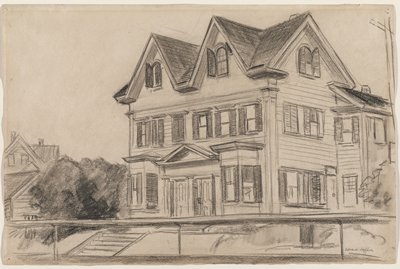
Double House, Gloucester
Edward Hopper
1923
- Medium
- Conté crayon
- Dimensions
- 12 x 18 in. (30.48 × 45.72 cm) 22 1/16 x 21 3/4 x 1 1/2 in. (56.04 x 55.25 x 3.81 cm) (outer frame)
- Genre
- Drawings
Tags
United States
About
Double House, Gloucester is typical of Edward Hopper’s approach to architectural subjects. It was executed in the 1920s, during one of the artist’s several trips to the Massachusetts seaside village of Gloucester. Hopper drew this Greek Revival wood-frame house from across the street, cropping out nearby structures to isolate his subject. The two-family house looms large within the composition, its slightly elevated position lending an even more imposing presence. Hopper rendered the complex formal structure in bold outline, precisely delineating the arrangement of windows, shutters, doors, and rchitectural details. Though it has no observable inhabitants, the solitary dwelling conceals an implicit human presence, a suspended narrative, suggested by the alternating pattern of open and shuttered windows that evokes the ebb and flow of daily life.