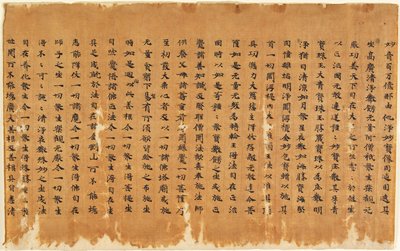
Buddhist Text: Fragment from Tun Huang Cave Sanctuary
- Medium
- Ink on paper
- Dimensions
- 10 3/8 x 16 1/4 in. (26.35 x 41.28 cm) (sheet)
- Genre
- Calligraphy
Tags
China
About
This rare fragment from an unidentified sutra is written in a seventeen-character format typical of the majority of the Buddhist manuscripts found in the famous Mogao cave sanctuaries at Dunhuang which yielded thousands of early Buddhist writings. Dating to the Sui dynasty (581-618), the paper has a smooth surface, horizontal chain lines, and is dyed yellow with herb juice to prevent insect damage. The exacting calligraphy is an early kai style executed with traces of li (clerical) script in the structure of each character. The writing is well-balanced and carefully structured with controlled brush strokes. The use of the taboo characters shih and qi indicating the second (627-49) and third (650-83) emperors of the Tang dynasty, implies that the manuscript predates those rulers placing it around 600 CE.