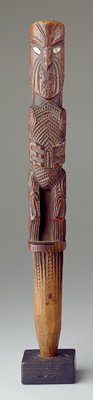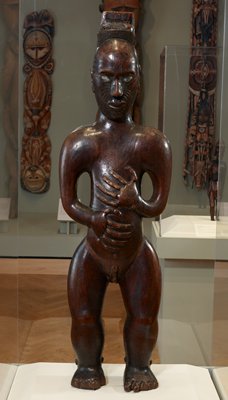
Post Figure (poutokomanawa)
Māori artist
1840
- Medium
- Wood, paua shell
- Dimensions
- 55 1/2 x 16 x 7 3/4 in. (141 x 40.6 x 19.7 cm) 51 3/8 in. (130.5 cm) (object part, bottom of foot to top of head)
- Genre
- Sculpture
Tags
New Zealand
About
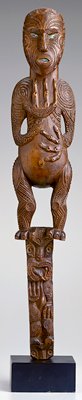
This poutokomanawa may have welcomed guests to a Māori communal house and protected its sacred essence. The Māori conceived of these houses as the physical embodiment of an ancestral spirit: the ridge pole represented the backbone, the side supports represented the ribs. The poutokomanawa, supporting the main beam in the center of the house, means “the post that supports the heart.” The figure is a portrait of the ancestor whose spiritual power infused the building, recognizable by the unique tattoo pattern carved on the face. The head, being the center of personal power, is larger than life. The large hands resting on the abdomen suggest spiritual strength and emphasize the life force that links spirits and humans. This poutokomanawa was carved by a member of the Ngāti Kahungunu tribal group of New Zealand.