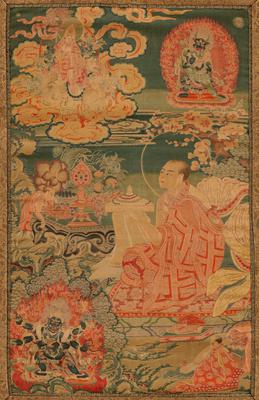
The Abbot Mkhas-grub Rje
- Medium
- Silk brocade (thag-drub-ma)
- Dimensions
- 33 1/2 x 23 3/4 in. (85.09 x 60.33 cm)
- Genre
- Textiles
Tags
China
About
This exceptionally fine silk brocade was probably woven in Peking for the Tibetan market. Some thankas were made from woodblock prints, painted and brought to Peking where Chinese weavers made copies on their looms. This thanka with its Chinese mounting is from a set of woven copies modeled after an earlier Tibetan painting. The Lamaist monk Mkhas-grub Rje (The Abbot Ka Drub) is shown here holding an offering to a vision of his teacher Tsong-Kha-pa the great reformer and founder of the Dge-lugs-pa school of Tibetan Buddhism. Tsong-Kha-pa is shown seated on an elephant mount in the upper left hand corner. Two monks assist Ka Drub, one in service at the altar, the other reciting scripture in the lower right. In the upper right corner is the conqueror of death (Yamantaka) and in the lower left the fierce protector of the Buddhist religion (Mahakala) all within a landscape setting.