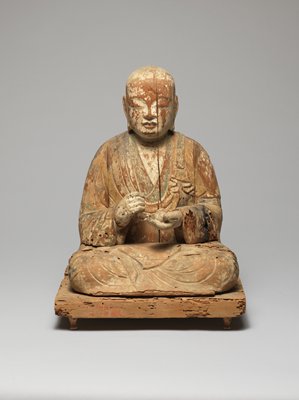
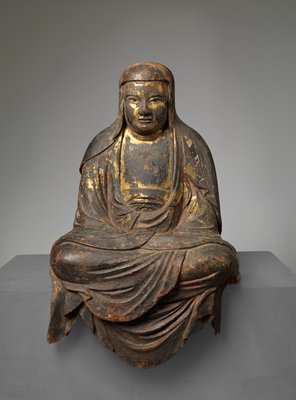
Hachiman in the Guise of a Buddhist Monk
- Medium
- Japanese cypress with polychrome
- Dimensions
- 16 5/8 × 11 3/8 × 9 3/4 in. (42.23 × 28.89 × 24.77 cm)
- Genre
- Sculpture
Tags
Japan
About
Buddhism was introduced to Japan through Korea after 500 and early Buddhists immediately set off to reconcile the new, foreign religion with the indigenous belief system of Shintō. According to the theory of honji suijaku (Shintō/Buddhist syncretism), Shintō kami (deities) were temporary embodiments of Buddhist deities on this earth, and specifically manifested themselves in Japan to save humans. Hachiman was a kami (deity) of war and archery. According to Shintō belief, Emperor Ōjin (270-310) became Hachiman after death. The worshipping of Hachiman was popular among samurai who traced their lineage back to the Emperor. Wearing a kesa, or wrap, over a robe and with a shaven head, Hachiman presents himself here as a Buddhist monk, reflecting the merging of different beliefs in one. This sculpture was once fully painted, and some traces of pigment—like the white skin, green on the robe, yellow and black on the kesa—remains on the surface.
![Netsuke [fox woman]](https://1.api.artsmia.org/30422.jpg)
![Izanaten [one of a set of Twelve Devas]](https://1.api.artsmia.org/10336.jpg)
![Netsuke [cluster of biwa]](https://1.api.artsmia.org/30490.jpg)