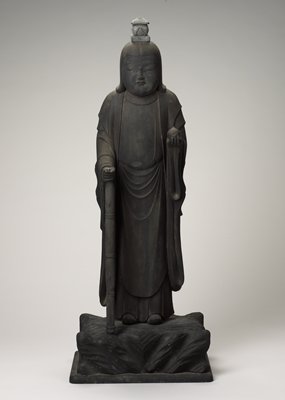
Uhōdōji, the Divine Rainmaking Boy
- Medium
- Wood
- Dimensions
- 42 x 11 x 8 in. (106.68 x 27.94 x 20.32 cm) 6 x 17 3/8 x 12 in. (15.24 x 44.13 x 30.48 cm) (base)
- Genre
- Sculpture
Tags
Japan
About
IIn Japan, anthropomorphic representations of indigenous Shinto gods were unknown before the adoption of Buddhism in the sixth century. Such gods were worshiped at sites associated with their presence: certain mountains, waterfalls, and unusually large rocks. Following the advent of Buddhism with its complex pantheon, Shintoists also began to make images. While sculptors fashioned Buddhist images in accordance with Indian and Chinese prototypes, they created Shinto images to resemble Japanese aristocrats. This sculpture is a rare representation of the Shinto god Uhōdōji, or the divine rainmaking boy. Uhōdōji is also a youthful manifestation of the Shinto sun goddess Amterasu-ōmikami. Demonstrating the fusion of Shinto and Buddhist beliefs in Japan, he holds a magic orb in his left hand, leans on a jeweled staff, and balances a treasure tower of wisdom on his head--all ritual implements associated with Buddhist worship.
![Izanaten [one of a set of Twelve Devas]](https://1.api.artsmia.org/10336.jpg)