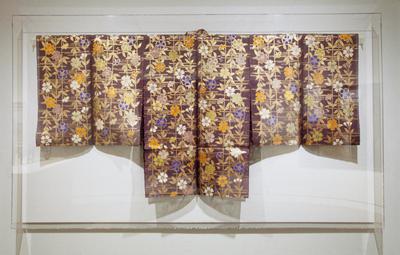
Noh costume (chōken)
- Medium
- Silk
- Genre
- Clothing
Tags
Japan
About
The Japanese evolved the stately Noh drama during the 14th and 15th centuries under the patronage of their aristocratic warrior rulers. Noh actors used poetic language, slow, stylized movements, masks, and resplendent costumes to create a dream-like atmosphere based on the ideal of yugen, or mysterious beauty. While actors first wore garments given to them by their princely patrons, by the end of the 16th century a specialized industry arose that supplied the great variety of costumes needed for the fully developed Noh theater. Chōken are one of several types of theatrical costumes worn during Noh performances and are distinguished by their wide sleeves, unlined gauze-weave fabric, and unstitched body panels that allowed the costume to flutter gracefully with the actor's dance. This chōken is woven with a design of cherry blossoms, long the most admired of all springtime flowers in Japan. The blossom's short life became emblematic of the transient nature of human existence, thus even this spectacularly beautiful chōken would have evoked melancholy sentiments when used in a Noh performance.
![Enmaten [one of a set of Twelve Devas]](https://1.api.artsmia.org/10338.jpg)

![Netsuke [Kappa on Clam]](https://1.api.artsmia.org/32054.jpg)
![Gatten, the Moon Deity [one of a set of Twelve Devas]](https://1.api.artsmia.org/10348.jpg)