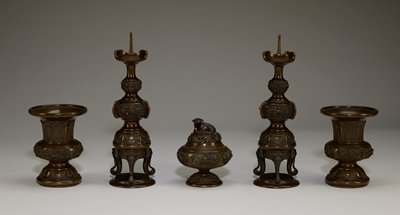
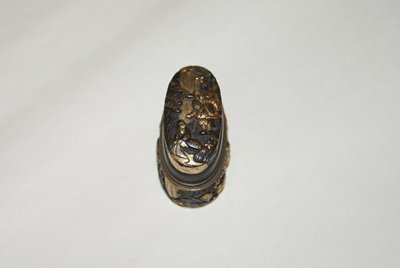
Incense burner, from a five-piece Buddhist altar set
- Medium
- Bronze
- Dimensions
- 4 3/4 x 3 13/16 x 3 13/16 in. (12.07 x 9.68 x 9.68 cm)
- Genre
- Metalwork
Tags
Japan
About
In East Asia, Buddhists place incense, flowers, and light (candles) before holy images as an expression of homage and to increase the magnificence of the worship hall. Incense is believed to purify the space, flowers constitute an offering or gift to the diety, and light symbolically illuminates the darkness of ignorance. Altar sets consisting of flower vases, candleholders, and incense burners were first brought to Japan by traveling priests in the 1200s. By the 1300s, the Japanese were casting their own versions, which were more subdued than their Chinese prototypes and often featured birds and flowers of the four seasons cast in high relief. Miniature altar sets, such as this one, were used in formal reception halls when the painting on display in the alcove represented a Buddhist diety.

![Netsuke [Sato No Tadanobu]](https://1.api.artsmia.org/30467.jpg)

![Manju [Two Running Rats]](https://1.api.artsmia.org/31581.jpg)