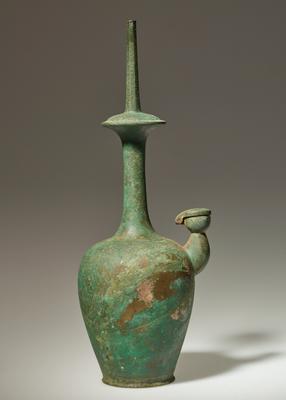
Buddhist Ritual Water Bottle
- Medium
- Bronze
- Dimensions
- 13 13/16 x 5 3/16 x 4 7/16 in. (35.08 x 13.18 x 11.27 cm)
Tags
China
About
Known as a kundi or kundika in Sanskrit, this uniquely shaped vessel was used during Buddhist rituals to sprinkle water for purification purposes. It was a standard ceremonial object and, along with the alms bowl, was considered a monk's necessity. The vessel type, originally imported from India during the early Tang dynasty, was usually made of metal; but by the early Song, stoneware versions had become the norm. A tall, slender neck of classic form with an ovoid body surmounts this elegant bottle with a disk-shaped flange below a narrow, tapered spout. A second spout rises from the shoulder capped by a cup-shaped mouth with flat-hinged cover. A similar water bottle was discovered on the Western Mountain in the tomb of the monk, Shen Hui, at Longmen near Luoyang in Henan province.