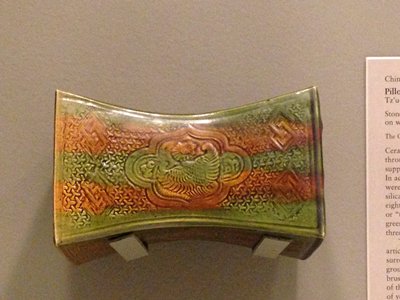
Pillow
China
1190
- Medium
- Cizhou ware Stoneware with molded, incised, and sgraffito decoration on white slip under green, yellow, and clear lead glaze
- Dimensions
- 3 7/8 x 11 x 5 3/4 in. (9.84 x 27.94 x 14.61 cm)
- Genre
- Ceramics
Tags
China
About
Ceramic pillows were produced over several centuries throughout China, but the northern Cizhou kilns supplied a volume and variety greater than all others. In addition to the predominant black and white designs, were Cizhou pillows decorated with colorful lead-silicate glazes in a technique that first flourished in the eighth century during the Tang dynasty. Called sancai or three-color ware, this technique usually combined green and yellow glazes on a cream slip to produce a three color effect. The décor of this quadrangular pillow is clearly articulated with a finely carved white lotus blossom surrounded by large stylized green leaves against a black ground. On the bottom, is a rare twenty-three character brushed ink inscription dating the piece to the first year of the emperor Ming Zhang's reign in the twelfth month of year gengwu. This accords with 1190 CE of the Jin dynasty. The name Liu Zhongyi also appears along with a partially obscured honorific title. Self-dated ceramics are extremely rare and this inscription points to the importance such works held for the well-furnished tomb.