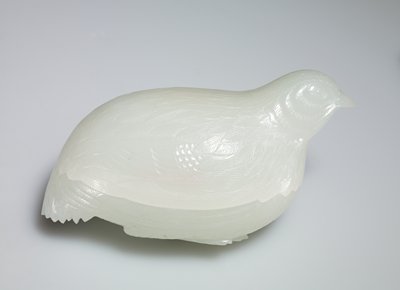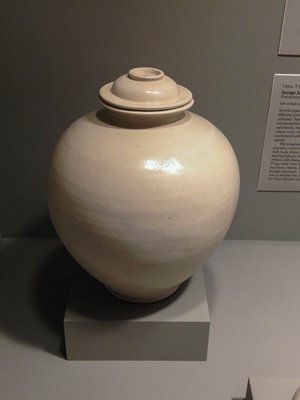
Storage Jar and Cover
- Medium
- Porcelaneous stoneware with clear glaze
- Dimensions
- 12-3/4 x 10-1/4 x 10-1/4 in. (32.4 x 26.0 x 26.0 cm)
- Genre
- Ceramics
Tags
China
About
Several types of white ware were manufactured in different parts of China during the Tang dynasty (618-906). Some vessels with rather elaborate low-relief ornamentation show the strong influence of Persian metalwork, but a jar such as this, severely plain with robust form, relies entirely on its smooth flow of uncluttered surface and pure white glaze for its aesthetic appeal. The progression from porcelaneous stoneware to true porcelain occurred during the Tang dynasty. Porcelains with hard, dense, impervious white, translucent bodies and hard glazes were achieved when white kaolin clays refined with feldspar were fired in excess of 1250° C. Tang white ware have been found at kiln sites in Sichuan, Shanxi, Hebei, Henan, Anhui, and Jiangxi provinces. The modern Jingdezhen in Jiangxi was to become the center of all porcelain production in the Yuan dynasty (1280-1368).