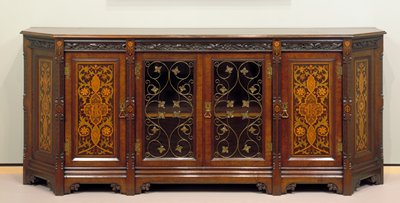
Side cabinet
- Medium
- Walnut with marquetry veneers, brass, glass
- Dimensions
- 39 1/8 x 90 11/16 x 21 5/16 in. (99.38 x 230.35 x 54.13 cm)
- Genre
- Furniture
Tags
England
About
No English designer or architect did more to promote the Gothic Revival than Augustus Welby Northmore Pugin. He argued against the ill effects of the Industrial Revolution and advocated a return to the honest craftsmanship of the Middle Ages. A convert to Catholicism, Pugin showcased his decoration in churches. Other commissions included some interiors of Windsor Castle in the 1820s (with his father Augustus Charles Pugin), the interiors of the Houses of Parliament in Westminster (executed under his direction during the 1840s), and the Mediaeval Court he created in 1851 for London's Crystal Palace Exhibition. Pugin displayed range of decorative motifs and materials in this cabinet, including intricate marquetry inlays, carved foliate friezes, and patinated brass grilles over the glazed doors. The initials AB and IB entwined in the marquetry panels refer to its original owners. Pugin had a number of private patrons such as the Earl of Shrewsbury and Earl Somers.Further research should reveal who commissioned the Institute's cabinet.