Length
Nobuko Kajitani
1968
- Medium
- Linen, a compound weave, handwoven fabric
- Dimensions
- 135 3/8 x 31 5/8 in. (343.84 x 80.32 cm)
- Genre
- Textiles
Tags
United States
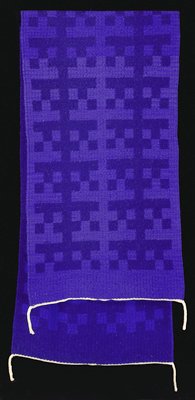
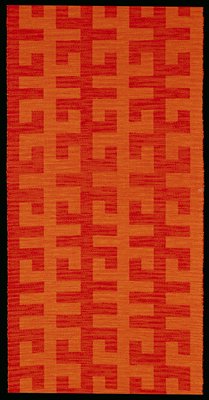
About
In 1969, the New York Guild of Handweavers sponsored a juried exhibition of textiles employing counterchange patterning. Counterchange refers to a reciprocal design in which foreground and background have the same pattern and are of equal visual importance. It was a favorite format of the well-known Dutch printmaker M.C. Escher. Nobuko Kajitani, a Japanese weaver living in the United States, used a contemporary adaptation of the complex weaving technique called taqueté to create this decorative hanging.