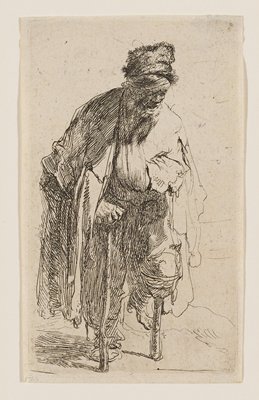
Beggar with a Wooden Leg
- Medium
- Etching
- Dimensions
- 4 7/16 x 2 5/8 in. (11.3 x 6.6 cm) (plate)
- Genre
Tags
netherlands
About
Beggars were a common sight on Dutch streets, so much so that Amsterdam passed an antibeggary law in 1613. The measure targeted vagabonds, idlers, the lame, and those pretending to be lame-like the subject of Beggar with a Wooden Leg, whose foot is visible behind his bound knee. Such rogues would be shipped to the workhouse to be reformed. While other artists depicted beggars as objects of derision or censure, Rembrandt chose to humanize them, attracted by the heroism of their decay and ruin.