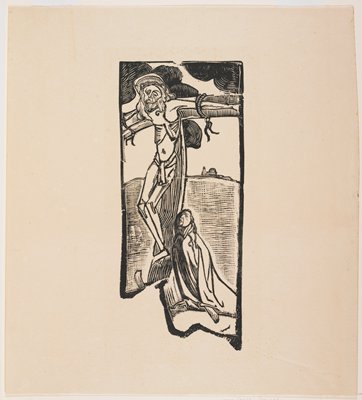
La Crucifixion
Émile Bernard
1890
- Medium
- Woodcut
- Dimensions
- 13 7/8 x 5 15/16 in. (35.24 x 15.08 cm) (image)
- Genre
Tags
france
About
Although produced in the spirit of a medieval woodcut, Émile Bernard's print is deceptively original. He achieved a primitive look by carving the coarse, unruly side-grain of a wood plank rather than the smoother end-grain, unheard of for a 19th-century artist. The narrow format borrows from Japanese hashira-e prints, which hung on pillars. And his angular, elongated Christ seems to prefigure German Expressionism. Using ropes on the cross was also novel; artists had switched to nails in the Middle Ages because they produced more blood.