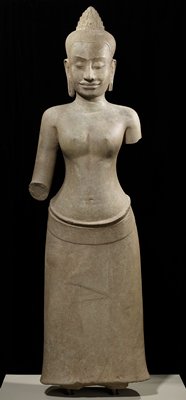
Prajnaparamita
- Medium
- Gray sandstone
- Dimensions
- 51 1/2 x 15 x 8 1/4 in. (130.81 x 38.1 x 20.96 cm)
- Genre
- Sculpture
Tags
Cambodia
About
The supple carving of bodily volumes lends this polished stone sculpture a levity and grace for which Khmer sculpture is renowned. It was likely created during the rule of King Jayavarman VII (reign c. 1181–1218), who identified himself with the Buddha and, in turn, equated his mother with Prajnaparamita, the mother of all Buddhas. He commissioned freestanding sculptures of the deity—the Goddess of Transcendent Wisdom—in the queen’s likeness, with a diminutive Buddha in her crown. This dual portrait demonstrates how the Khmer Empire (802–1437 CE) adopted the Indian concept of Deva-Raja (God-King) and established its rule with divine order.